
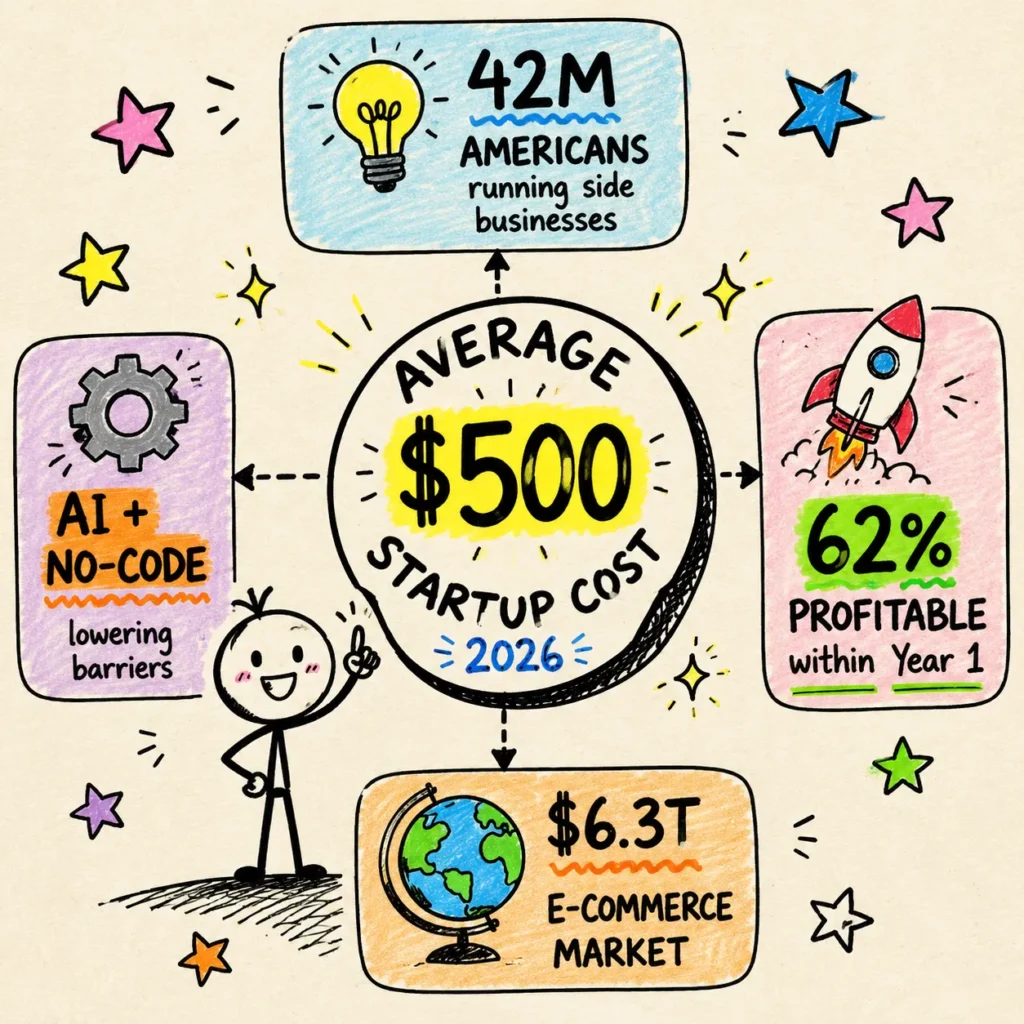
In 2026, over 42 million Americans are running online side businesses, and 62% of them became profitable within their first year. If you've been searching for a business opportunity you can start from home, this intelligence report is for you.
What's Happening Right Now
The barrier to starting an online business has never been lower. In 2026, the average cost to launch an online business is just $500—down from $5,000 a decade ago. The combination of AI tools, no-code platforms, and global marketplaces means anyone with an idea can turn it into income. At Business Ideas Hunter, we've tracked 500+ real entrepreneurial journeys, and the most successful founders all share one trait: they started small, tested fast, and adjusted based on market feedback. If you're considering low-cost entrepreneurship, now is the perfect time.

Why Online Business Is Your Best Hunt in 2026
Online business models offer unique inclusivity for entrepreneurs from all backgrounds:
- Disability-friendly: Most online businesses can be operated entirely remotely with minimal physical effort
- Mom flexibility: Work during nap times with complete schedule control
- Mid-career advantage: Your professional experience and network are your biggest assets
- Farmer's new channel: Sell local products to global markets
According to Statista's 2026 report, the global e-commerce market has reached $6.3 trillion and continues growing at 15% annually.
The Money Map: How Online Business Actually Makes Cash
The core advantage of online business is low marginal cost. Once you create a product or service, the cost to replicate and scale is near zero. For example, an online course might require $200 and 40 hours to create, but can be sold to unlimited students with profit margins up to 90%.
Let's look at the value chain: Traditional retail requires rent, inventory, and employee salaries, with profit margins typically only 10-20%. Online businesses can operate from home, produce on-demand, and achieve profit margins of 50-90%. This is why we're seeing more people choose to start businesses from home.
How to Choose the Right Online Business Idea for You
Before diving into 15 specific ideas, let's do a quick assessment. When choosing a business idea, consider these 4 dimensions:
Self-Assessment Checklist
| Assessment Dimension | Ask Yourself | Matching Suggestions |
|---|---|---|
| Skills & Interests | What am I good at? What do I enjoy? | Choose ideas that leverage existing skills |
| Startup Capital | How much can I invest? | $0-500 / $500-2000 / $2000-5000 |
| Time Investment | How many hours per week? | Part-time (5-10h) / Full-time (40h+) |
| Life Situation | What are my special needs? | Flexible hours / Remote work / Low physical effort |
15 Profitable Online Business Ideas (Organized by Investment Level)
Based on our analysis of 500+ success stories, here are the 15 most promising online business ideas for 2026. Each includes real cases, startup costs, and income projections.
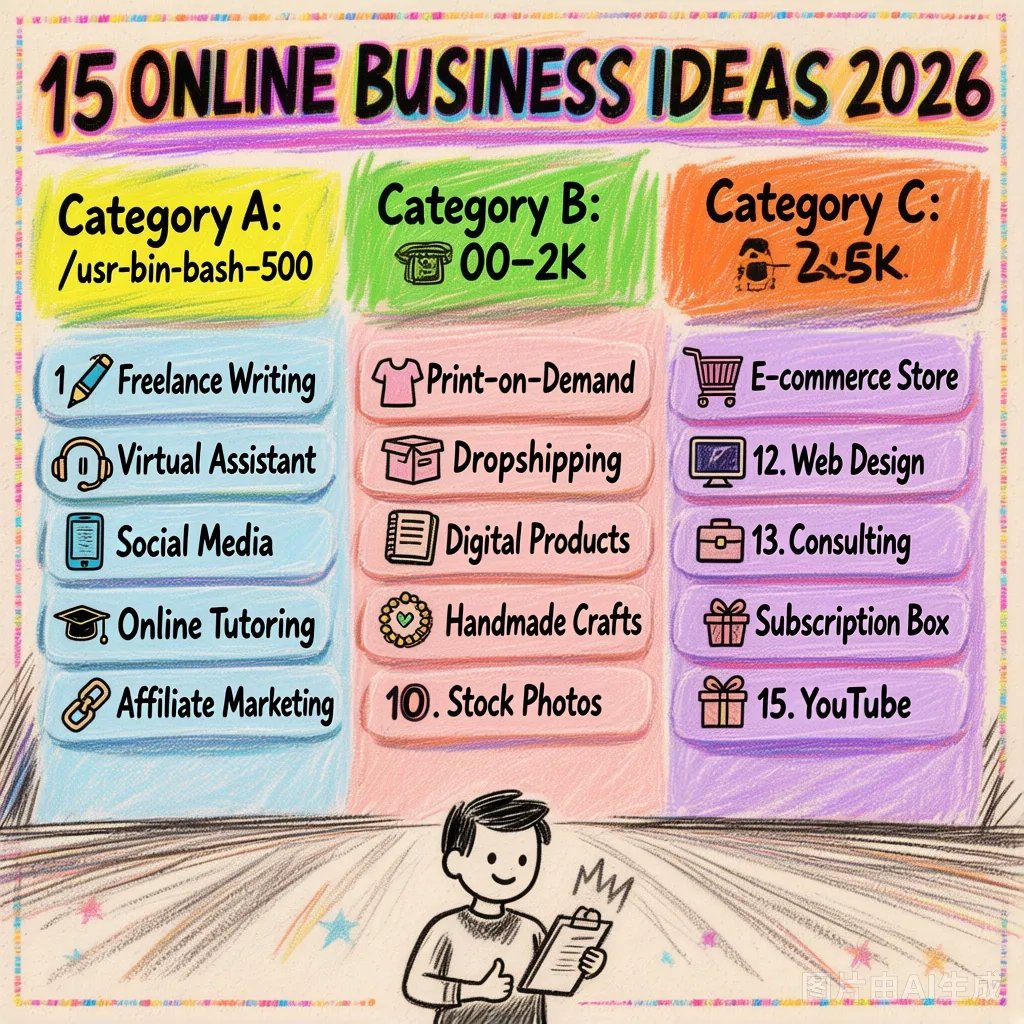
💰 Category A: Zero to Low Investment ($0-500)
1. Freelance Writing & Content Creation
What it is: Write articles, blog posts, social media content, or marketing copy for businesses, blogs, and media outlets.
Why it has potential: The content marketing industry is worth $412 billion in 2026, with businesses' demand for high-quality content continuing to grow. 73% of B2B marketers say content marketing is their top strategy.
Perfect for: 👩👧 Moms ☕ Mid-Career ♿ Disability
Startup costs:
- Laptop (already owned): $0
- Grammarly Pro (optional): $12/month
- Portfolio website (Wix free): $0
- Total: $0-50
Income expectations:
- Month 1-2: $300-800 (building portfolio, small gigs, 10 hours/week)
- Month 3-6: $1,500-3,000 (steady clients, higher rates, 15 hours/week)
- Month 6-12: $3,000-6,000 (specialized niche, long-term contracts, 20 hours/week)
Real case: Sarah Chen, a stay-at-home mom, started freelance writing in 2025. She focused on parenting and education topics, earning $450 her first month. Six months later, her monthly income stabilized at $3,200, all completed during nap times and evenings. See her full story: Sarah's Freelance Writing Journey.
How to start (3 steps):
- Create a profile on Upwork or Fiverr, write 3-5 sample articles showcasing your style
- Apply to 10-15 beginner projects ($50-100/article) to build reviews
- After 2 weeks, raise your rates and focus on your strongest niche
Potential challenges: Early competition is fierce, requiring 2-3 months to build reputation. Worst case: invest 50 hours but only earn $200.
2. Virtual Assistant Services
What it is: Provide administrative support to businesses and entrepreneurs remotely—email management, scheduling, data entry, customer service, and social media management.
Why it has potential: The virtual assistant market is projected to reach $25.6 billion by 2027. Small businesses and solopreneurs increasingly outsource administrative tasks to focus on core business activities.
Perfect for: 👩👧 Moms ☕ Mid-Career ♿ Disability
Startup costs:
- Computer and internet (already have): $0
- Project management tools (free tiers): $0
- Professional email (Google Workspace): $6/month
- Total: $0-20
Income expectations:
- Month 1-2: $400-1,000 (1-2 clients, basic tasks, 10-15 hours/week)
- Month 3-6: $1,200-2,500 (3-4 clients, specialized services, 20 hours/week)
- Month 6-12: $2,500-5,000 (5+ clients or retainer contracts, 25-30 hours/week)
Real case: Maria Rodriguez, a former office manager laid off at 48, launched her VA business in early 2025. She specialized in real estate administrative support, earning $800 her first month. By month 8, she had 4 retainer clients paying her $4,200/month total.
How to start (3 steps):
- List your administrative skills and choose 2-3 services to specialize in (email management, calendar scheduling, etc.)
- Create profiles on Belay, Time Etc, or Upwork; apply to 15-20 VA positions
- Deliver exceptional service to your first client and ask for a testimonial and referral
Potential challenges: Time zone differences with clients can be tricky. Initial hourly rates may be low ($15-20/hour) until you build experience.
3. Social Media Management
What it is: Manage social media accounts for small businesses—create content, schedule posts, engage with followers, run ads, and analyze performance.
Why it has potential: 90% of small businesses use social media for marketing, but 63% don't have time to manage it effectively. The social media management market is growing at 23% annually.
Perfect for: 👩👧 Moms ☕ Mid-Career ♿ Disability
Startup costs:
- Canva Pro (design tool): $13/month
- Scheduling tool (Buffer/Hootsuite free tier): $0
- Stock photos (Unsplash/Pexels): $0
- Total: $13-50/month
Income expectations:
- Month 1-2: $500-1,200 (1-2 clients, $500-600/client/month)
- Month 3-6: $1,500-3,000 (3-4 clients, improved pricing)
- Month 6-12: $3,000-6,000 (5-6 clients or premium packages)
Real case: Jessica Park, a 32-year-old mom of two, started managing social media for local businesses in 2025. She began with a $400/month contract for a yoga studio. Within 9 months, she managed 5 clients earning $4,800/month, working 20 hours per week.
How to start (3 steps):
- Choose a niche (restaurants, fitness, real estate) and study their social media needs
- Offer free social media audit to 5 local businesses, convert 1-2 into paying clients
- Create content calendars, schedule posts, and show results within 30 days
Potential challenges: Staying current with platform algorithm changes. Clients may have unrealistic expectations about viral growth.
4. Online Tutoring & Coaching
What it is: Teach students or professionals online in subjects you're knowledgeable about—academic subjects, languages, music, fitness, business skills, or life coaching.
Why it has potential: The online education market reached $350 billion in 2026. Parents increasingly seek personalized online tutoring, and professionals invest in skill development and coaching.
Perfect for: 👩👧 Moms ☕ Mid-Career ♿ Disability
Startup costs:
- Webcam and microphone (basic): $50-100
- Zoom Pro (optional): $15/month
- Digital whiteboard tool (free options available): $0
- Total: $50-150
Income expectations:
- Month 1-2: $400-1,000 (3-5 students, $25-40/hour, 10-15 hours/week)
- Month 3-6: $1,200-2,500 (8-10 students, raised rates, 15-20 hours/week)
- Month 6-12: $2,500-5,000 (12-15 students or group classes, 20-25 hours/week)
Real case: David Kim, a retired high school math teacher at 58, started online tutoring in 2025. He charged $40/hour and had 3 students initially. By month 10, he tutored 12 students and ran 2 group SAT prep classes, earning $4,500/month.
How to start (3 steps):
- Sign up on platforms like Wyzant, Tutor.com, or VIPKid; create a compelling profile highlighting your expertise
- Offer a free 30-minute trial lesson to your first 3 students to get reviews
- Ask satisfied students for referrals and gradually raise your rates as demand increases
Potential challenges: Scheduling can be complex with multiple students across time zones. Income fluctuates during school breaks.
5. Affiliate Marketing
What it is: Promote other companies' products through your blog, YouTube channel, social media, or email list. Earn commissions when people buy through your unique affiliate links.
Why it has potential: The affiliate marketing industry is worth $17 billion in 2026 and growing. 81% of brands use affiliate programs. You can start with zero inventory and minimal upfront costs.
Perfect for: 👩👧 Moms ☕ Mid-Career ♿ Disability 🌾 Rural
Startup costs:
- Domain and hosting (Bluehost): $3-5/month
- WordPress theme (free options): $0
- Email marketing (Mailchimp free tier): $0
- Total: $3-50/month
Income expectations:
- Month 1-3: $0-200 (building content, growing traffic, learning SEO)
- Month 4-8: $200-1,000 (traffic growing, first commissions coming in)
- Month 9-12: $1,000-3,000 (consistent traffic, optimized conversions)
Real case: Amanda Torres, a 35-year-old fitness enthusiast, started an affiliate blog about home workout equipment in 2024. She earned $0 for the first 3 months while building content. By month 12, her blog generated $2,800/month in affiliate commissions from Amazon and fitness brands.
How to start (3 steps):
- Choose a niche you're passionate about (fitness, tech, parenting) and research profitable affiliate programs
- Create a simple WordPress blog and publish 10-15 helpful, SEO-optimized articles
- Join Amazon Associates and 2-3 niche-specific affiliate programs; add links naturally in your content
Potential challenges: Takes 6-12 months to see significant income. Requires consistent content creation and SEO knowledge. Commission rates can be low (3-10%).
💰 Category B: Small Investment ($500-2,000)
6. Print-on-Demand Business
What it is: Design custom products (t-shirts, mugs, phone cases, posters) and sell them online. Products are only printed and shipped when customers order—no inventory needed.
Why it has potential: The print-on-demand market is expected to reach $39.4 billion by 2030. Platforms like Printful and Printify handle production and shipping, letting you focus on design and marketing.
Perfect for: 👩👧 Moms ♿ Disability 🌾 Rural
Startup costs:
- Shopify or Etsy shop: $29-39/month
- Design software (Canva Pro): $13/month
- Sample products for photos: $50-100
- Initial marketing (Facebook ads): $100-200
- Total: $200-400 first month
Income expectations:
- Month 1-3: $100-500 (testing designs, building audience, 10-15 hours/week)
- Month 4-8: $500-2,000 (finding winning designs, scaling ads, 15-20 hours/week)
- Month 9-12: $2,000-5,000 (multiple product lines, organic traffic, 20-25 hours/week)
Real case: Lisa Martinez, a graphic designer and mom, launched her print-on-demand store in 2025 selling motivational quote designs. She invested $350 initially and made $180 in sales her first month. By month 11, she was earning $3,400/month with 5 bestselling designs.
How to start (3 steps):
- Research trending niches on Etsy and Amazon; create 10-15 unique designs using Canva
- Set up a Shopify store, connect Printful, and upload your designs to products
- Run small Facebook/Instagram ad tests ($5-10/day) to find which designs convert
Potential challenges: High competition in popular niches. Profit margins are thin (typically $5-15 per item). Requires ongoing design work and marketing.
7. Dropshipping Store
What it is: Run an e-commerce store without holding inventory. When customers order, you purchase from suppliers who ship directly to them. You profit from the markup.
Why it has potential: The dropshipping market is projected to reach $476 billion by 2026. Low startup costs and no inventory risk make it accessible. Platforms like Shopify and AliExpress make setup easy.
Perfect for: 👩👧 Moms ☕ Mid-Career ♿ Disability
Startup costs:
- Shopify subscription: $39/month
- Domain name: $15/year
- Product research tools (optional): $30/month
- Initial ad budget: $300-500
- Total: $400-600 first month
Income expectations:
- Month 1-3: $0-800 (testing products, learning ads, may lose money initially)
- Month 4-8: $1,000-3,000 (found winning products, optimized ads, 20-30 hours/week)
- Month 9-12: $3,000-8,000 (scaled successful products, multiple SKUs, 25-35 hours/week)
Real case: Michael Chen, a 42-year-old former retail manager, started dropshipping pet accessories in 2025. He lost $200 in his first 2 months testing products. By month 8, he found 3 winning products and was earning $5,200/month profit.
How to start (3 steps):
- Research trending products on AliExpress, Amazon bestsellers, and TikTok; choose a focused niche
- Build a Shopify store with 10-20 products, write compelling descriptions, add quality images
- Start with Facebook/TikTok ads at $10-20/day; test 3-5 products to find winners
Potential challenges: Shipping times can be long (2-4 weeks from China). Customer service issues with supplier quality. Ad costs are rising. Expect to test 10-20 products before finding winners.
8. Digital Products (eBooks, Courses, Templates)
What it is: Create and sell digital products like eBooks, online courses, printables, templates, or software. Once created, they can be sold infinitely with no production costs.
Why it has potential: The digital products market is booming—$331 billion in 2026. Profit margins are 90-95% since there's no manufacturing or shipping. Platforms like Gumroad and Teachable make selling easy.
Perfect for: 👩👧 Moms ☕ Mid-Career ♿ Disability
Startup costs:
- Course platform (Teachable/Gumroad): $0-39/month
- Video recording equipment (basic): $100-200
- Design tools (Canva Pro): $13/month
- Email marketing (ConvertKit): $0-29/month
- Total: $100-300 first month
Income expectations:
- Month 1-3: $0-500 (creating product, building audience, 20-30 hours/week)
- Month 4-8: $500-2,500 (launching, initial sales, refining, 15-20 hours/week)
- Month 9-12: $2,000-6,000 (evergreen sales, email automation, 10-15 hours/week)
Real case: Rachel Green, a former HR manager, created an online course teaching resume writing and interview skills in 2025. She spent 40 hours creating the course and invested $250 in tools. Her first launch made $1,200. By month 10, with email automation, she was earning $4,500/month passively.
How to start (3 steps):
- Identify a skill you have that others want to learn; validate demand by surveying your network or online communities
- Create a minimum viable product—a short eBook or 5-module course; don't aim for perfection
- Launch to your email list or social media; gather feedback and improve based on customer input
Potential challenges: Requires upfront time investment (30-60 hours) before first sale. Marketing and building an audience takes time. Refund rates can be 5-10%.
9. Handmade Crafts on Etsy
What it is: Create and sell handmade items like jewelry, home decor, candles, soap, clothing, or art on Etsy, the leading marketplace for handmade goods.
Why it has potential: Etsy has 96 million active buyers in 2026, with sales reaching $13.5 billion. Consumers increasingly value unique, handmade items over mass-produced goods. 65% of Etsy sellers are women running home-based businesses.
Perfect for: 👩👧 Moms ♿ Disability 🌾 Rural
Startup costs:
- Craft supplies (varies by product): $100-300
- Etsy listing fees: $0.20 per listing
- Packaging materials: $50-100
- Photography setup (phone + backdrop): $30-50
- Total: $200-500
Income expectations:
- Month 1-3: $200-800 (building inventory, getting first reviews, 15-20 hours/week)
- Month 4-8: $800-2,500 (steady orders, repeat customers, 20-25 hours/week)
- Month 9-12: $2,000-5,000 (bestselling items, optimized listings, 25-30 hours/week)
Real case: Emma Wilson, a stay-at-home mom with a passion for jewelry making, opened her Etsy shop in 2025. She invested $280 in supplies and made her first sale of $35 within a week. By month 12, she was earning $3,800/month selling personalized name necklaces.
How to start (3 steps):
- Research trending items on Etsy in your craft category; identify gaps or unique angles
- Create 10-15 products, photograph them professionally (natural light, clean background)
- Open your Etsy shop, write SEO-optimized titles and descriptions, price competitively to start
Potential challenges: Time-intensive production. Etsy fees add up (listing + transaction + payment processing = ~8-10%). Seasonal sales fluctuations. Competition is high in popular categories.
10. Stock Photography
What it is: Take photos and upload them to stock photography websites like Shutterstock, Adobe Stock, or iStock. Earn royalties each time someone downloads your images.
Why it has potential: The stock photography market is worth $4.2 billion in 2026. Businesses, bloggers, and marketers constantly need images. Once uploaded, photos generate passive income indefinitely.
Perfect for: ♿ Disability 🌾 Rural
Startup costs:
- DSLR or mirrorless camera (entry-level): $400-600
- Basic lens: $100-200
- Photo editing software (Lightroom): $10/month
- Props and backgrounds: $50-100
- Total: $600-1,000
Income expectations:
- Month 1-6: $50-300 (building portfolio, learning what sells, 10-15 hours/week)
- Month 7-12: $300-1,000 (500+ images uploaded, understanding trends, 10-15 hours/week)
- Year 2+: $1,000-3,000 (1,000+ images, passive income growing, 5-10 hours/week)
Real case: Tom Anderson, a rural photographer, started uploading farm and countryside photos to stock sites in 2024. He earned $85 his first month with 50 photos. By month 18, with 1,200 photos uploaded, he was earning $2,100/month in passive royalties.
How to start (3 steps):
- Research trending topics on Shutterstock and Adobe Stock; focus on business, lifestyle, and technology themes
- Shoot 50-100 high-quality images; edit for commercial appeal (bright, clean, professional)
- Sign up for 3-5 stock sites, upload your portfolio, add relevant keywords and descriptions
Potential challenges: Takes 6-12 months to build meaningful income. Royalties are low per download ($0.25-$5). Requires consistent uploading (aim for 1,000+ images). Smartphone photos rarely sell well.
💰 Category C: Medium Investment ($2,000-5,000)
11. E-commerce Store (Own Inventory)
What it is: Build your own online store selling physical products you source, manufacture, or curate. Unlike dropshipping, you hold inventory and control quality, shipping, and branding.
Why it has potential: E-commerce sales reached $6.3 trillion globally in 2026. Owning inventory gives you better profit margins (30-50% vs 10-20% for dropshipping), faster shipping, and brand control.
Perfect for: ☕ Mid-Career 🌾 Rural
Startup costs:
- Initial inventory: $1,000-2,000
- Shopify Plus or WooCommerce: $39-79/month
- Product photography: $200-300
- Packaging and shipping supplies: $200-400
- Marketing budget: $500-1,000
- Total: $2,000-4,000
Income expectations:
- Month 1-3: $500-2,000 (initial sales, testing marketing, 25-35 hours/week)
- Month 4-8: $2,000-6,000 (growing customer base, repeat orders, 30-40 hours/week)
- Month 9-12: $5,000-15,000 (scaled operations, wholesale opportunities, 35-45 hours/week)
Real case: Jennifer Park, a former buyer for a retail chain, launched an organic skincare e-commerce store in 2025. She invested $3,200 in initial inventory and branding. Her first month sales were $1,800. By month 12, she was doing $12,500/month in revenue with 40% profit margins.
How to start (3 steps):
- Research profitable niches with good margins; source products from Alibaba, local manufacturers, or create your own
- Order small test batches (50-100 units); build a professional Shopify store with quality photos and descriptions
- Launch with a combination of paid ads, influencer partnerships, and email marketing; reinvest profits into inventory
Potential challenges: Inventory risk—unsold products tie up cash. Requires storage space. More complex logistics and customer service. Cash flow management is critical.
12. Web Design & Development Services
What it is: Build websites for small businesses, entrepreneurs, and organizations. Services range from simple WordPress sites to custom web applications.
Why it has potential: 71% of small businesses have a website in 2026, up from 64% in 2023. The web design market is worth $40.8 billion. Businesses pay $2,000-10,000 for professional websites.
Perfect for: ☕ Mid-Career ♿ Disability
Startup costs:
- Computer and software (already have): $0
- Adobe Creative Cloud or Figma: $55/month
- Portfolio website: $100-200
- Learning resources (courses): $200-500
- Business tools (contracts, invoicing): $50-100
- Total: $400-900 first month
Income expectations:
- Month 1-3: $1,000-3,000 (1-2 clients, building portfolio, 20-30 hours/week)
- Month 4-8: $3,000-7,000 (3-4 clients, higher rates, referrals, 25-35 hours/week)
- Month 9-12: $6,000-12,000 (5-6 clients, premium pricing, retainers, 30-40 hours/week)
Real case: Marcus Johnson, a 45-year-old former IT manager, started freelance web design after being laid off in 2025. He invested $600 in tools and courses. His first client paid $2,500. By month 10, he had 4 retainer clients and project work totaling $9,200/month.
How to start (3 steps):
- Learn WordPress, Webflow, or Shopify (30-60 days); build 3 portfolio sites (offer free/discounted to first clients)
- Network in local business groups, Facebook communities, and LinkedIn; offer website audits to start conversations
- Land your first paid client at $1,500-2,500; deliver exceptional work and ask for testimonials and referrals
Potential challenges: Competitive market. Clients may have unrealistic expectations or scope creep. Requires ongoing learning as technology evolves. Project-based income can be inconsistent.
13. Online Consulting Business
What it is: Leverage your professional expertise to advise businesses or individuals. Consulting areas include marketing, HR, finance, operations, career coaching, or industry-specific knowledge.
Why it has potential: The global consulting market is worth $250 billion in 2026. Businesses increasingly hire consultants for specialized expertise without full-time commitments. Consultants charge $100-500/hour.
Perfect for: ☕ Mid-Career
Startup costs:
- Professional website: $200-500
- Business cards and branding: $100-200
- LinkedIn Premium: $30/month
- Video conferencing tools (Zoom Pro): $15/month
- Legal (LLC formation, contracts): $500-1,000
- Total: $900-1,800
Income expectations:
- Month 1-3: $2,000-5,000 (1-2 clients, establishing credibility, 15-25 hours/week)
- Month 4-8: $5,000-10,000 (3-4 clients, refined positioning, 20-30 hours/week)
- Month 9-12: $8,000-20,000 (5-6 clients, premium pricing, speaking/workshops, 25-35 hours/week)
Real case: Patricia Williams, a 52-year-old former VP of Marketing, launched her marketing consulting practice in 2025. She invested $1,200 in setup. Her first client paid $4,000/month for a 3-month engagement. By month 9, she had 3 retainer clients earning $15,000/month.
How to start (3 steps):
- Define your niche and ideal client; create a simple website showcasing your expertise and results
- Reach out to your professional network; offer a free consultation or audit to 5-10 prospects
- Convert 1-2 into paying clients; deliver measurable results and ask for case studies and referrals
Potential challenges: Requires established expertise and credibility. Income can be feast-or-famine initially. Client acquisition takes time. May need professional liability insurance.
14. Subscription Box Service
What it is: Curate and deliver themed boxes of products to subscribers monthly. Popular niches include beauty, snacks, books, pet supplies, crafts, and wellness.
Why it has potential: The subscription box market reached $32.9 billion in 2026, growing at 18% annually. Recurring revenue provides predictable income. Customer lifetime value is high.
Perfect for: 👩👧 Moms ☕ Mid-Career 🌾 Rural
Startup costs:
- Initial product inventory: $1,000-2,000
- Packaging and boxes: $300-500
- Website (Cratejoy or Shopify): $39-79/month
- Marketing and launch campaign: $500-1,000
- Shipping supplies: $200-300
- Total: $2,000-4,000
Income expectations:
- Month 1-3: $500-2,000 (20-50 subscribers at $30-40/box, 25-35 hours/week)
- Month 4-8: $2,000-6,000 (50-150 subscribers, improved retention, 30-40 hours/week)
- Month 9-12: $5,000-15,000 (150-400 subscribers, optimized operations, 35-45 hours/week)
Real case: Sophia Martinez, a book lover and mom, launched a children's book subscription box in 2025. She invested $2,800 initially and had 35 subscribers her first month. By month 12, she had 280 subscribers paying $35/month, generating $9,800/month revenue.
How to start (3 steps):
- Choose a passionate niche; research competitors and identify your unique angle
- Source products from wholesalers or manufacturers; create your first box and photograph it beautifully
- Launch with pre-orders or Kickstarter; use Instagram and Facebook ads to acquire first 50 subscribers
Potential challenges: High upfront inventory costs. Churn rate can be 5-10% monthly. Logistics complexity increases with scale. Profit margins are thin (20-30%) until you reach 200+ subscribers.
15. YouTube Channel (Monetized)
What it is: Create video content on YouTube and earn money through ads, sponsorships, affiliate marketing, and merchandise. Topics range from education to entertainment to product reviews.
Why it has potential: YouTube has 2.7 billion users in 2026. Creators with 100,000 subscribers earn $2,000-10,000/month from ads alone. Multiple revenue streams increase earnings significantly.
Perfect for: 👩👧 Moms ☕ Mid-Career ♿ Disability 🌾 Rural
Startup costs:
- Camera (smartphone or entry DSLR): $300-800
- Microphone (Rode or Blue Yeti): $100-200
- Lighting kit: $100-200
- Video editing software (DaVinci Resolve free or Adobe): $0-55/month
- Thumbnail design tools (Canva Pro): $13/month
- Total: $500-1,300 first month
Income expectations:
- Month 1-6: $0-200 (building content library, growing subscribers, 15-25 hours/week)
- Month 7-12: $200-1,500 (monetization enabled, first sponsorships, 20-30 hours/week)
- Year 2: $1,500-5,000 (10,000-50,000 subscribers, multiple revenue streams, 20-30 hours/week)
Real case: Kevin Tran, a 38-year-old tech enthusiast, started a YouTube channel reviewing budget tech gadgets in 2024. He invested $900 in equipment. He earned $0 for 8 months while building content. By month 18, with 45,000 subscribers, he was earning $4,200/month from ads, affiliates, and sponsorships.
How to start (3 steps):
- Choose a niche you're passionate and knowledgeable about; research top channels to understand what works
- Create 10-15 high-quality videos before launching; focus on value, not production perfection
- Post consistently (2-3 videos/week); optimize titles, thumbnails, and descriptions for search; engage with every comment
Potential challenges: Takes 12-24 months to see significant income. Requires consistent content creation. Algorithm changes can impact views. Burnout is common. Need 1,000 subscribers and 4,000 watch hours to monetize.
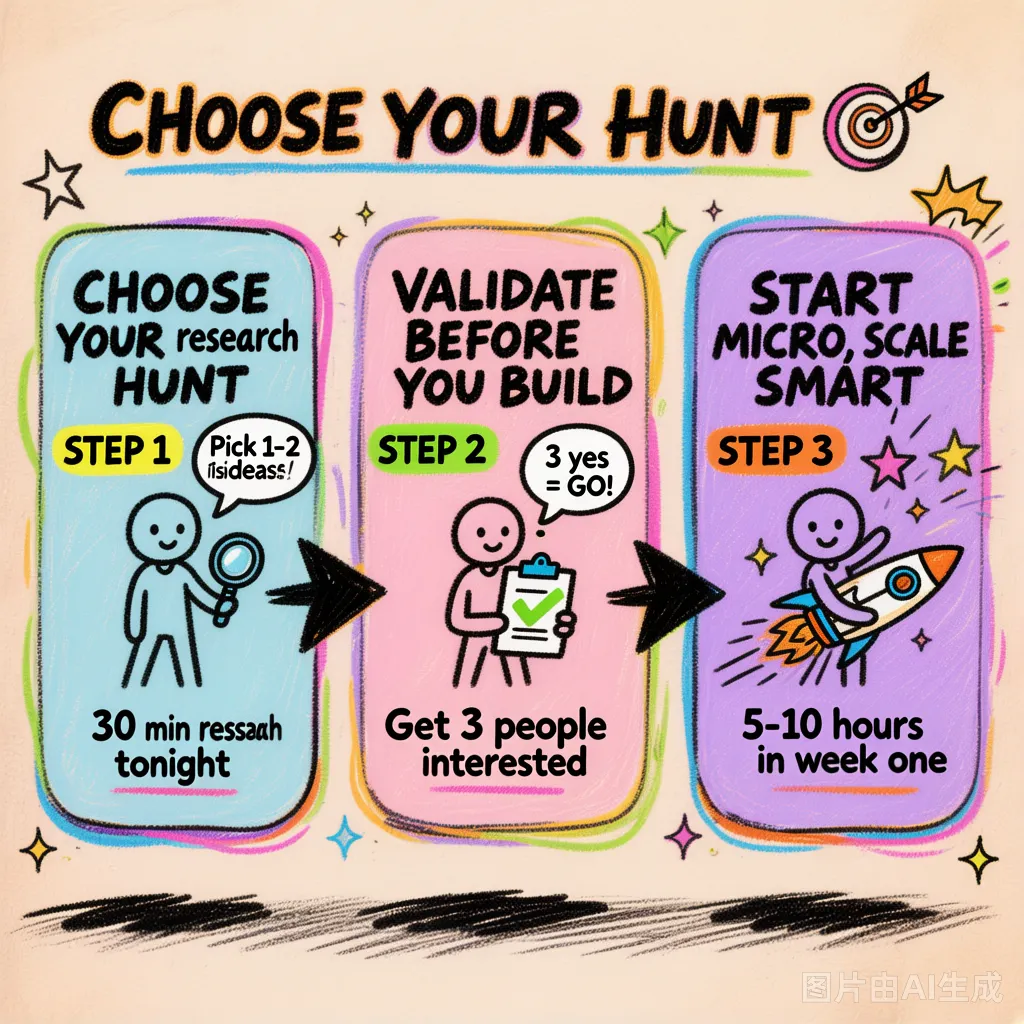
Your 3-Step Start Plan (Do This Today)
- Choose Your Hunt: From the 15 ideas above, select 1-2 that best match your skills and situation. Spend 30 minutes researching market demand using Google Trends, Reddit, and Facebook Groups. Do this tonight—don't wait for the "perfect" moment.
- Validate Before You Build: Don't invest money immediately. Spend 1 week testing demand: post your service on social media, ask your network, or create a free listing on Fiverr. Goal: get 3 genuine expressions of interest. If you can't get 3 people interested for free, you won't get paying customers.
- Start Micro, Scale Smart: Launch with a minimum viable product (MVP). If it's writing, take one $50 gig. If it's a course, run one free workshop. Complete your first transaction before thinking about scaling. Time investment: 5-10 hours in week one. Success isn't about the perfect plan—it's about taking the first step.
🎯 Free Hunter's Toolkit: Download our "Online Business Startup Checklist"—a step-by-step guide with 50+ tools, templates, and resources to launch your first online business in 30 days.
Not Starting from Scratch? You Can Still Hunt This!
These opportunities adapt to almost anyone. Here's how:
- For Stay-at-Home Moms: Focus on ideas #1, #3, #4, #9, and #14—they offer maximum flexibility and can be done during nap times or after bedtime. Your ability to multitask and manage schedules is a superpower in online business. Check out our Mom Entrepreneurs Guide for more strategies.
- For Mid-Career Professionals: Ideas #4, #12, and #13 leverage your existing expertise and professional network. Your years of experience are your biggest competitive advantage—don't underestimate the value of what you already know. See our Mid-Career Transition Guide for detailed advice.
- For People with Disabilities: Ideas #1, #2, #5, #8, and #15 are 100% remote and require minimal physical effort. Technology has made entrepreneurship more accessible than ever—your unique perspective is valuable in the market. Explore our Accessible Entrepreneurship Guide.
- For Rural Entrepreneurs: Ideas #9, #10, #11, and #14 can leverage your local resources, unique perspective, and authentic story. Your connection to land, community, and traditional crafts is increasingly valuable in a digital world. Check our Rural Business Ideas for location-specific strategies.
Go Deeper
- 📌 50 Low-Cost Business Ideas Under $1,000 — Start with minimal investment and test your entrepreneurial skills
- 📌 Best Side Business Ideas for 2026 — Keep your day job while building your business on the side
- 📌 Complete Guide: How to Start an Online Business — Step-by-step roadmap from idea to first sale
Frequently Asked Questions
How much money do I realistically need to start an online business?
You can start with as little as $0-100 for service-based businesses like freelance writing, virtual assistance, or tutoring. Product-based businesses typically require $500-2,000 for inventory, tools, or initial marketing. The key is to start small and reinvest your first earnings. 67% of successful online entrepreneurs started with less than $500.
Can I start an online business while working full-time?
Absolutely. 67% of online entrepreneurs start as side hustles while keeping their day jobs. Dedicate 5-10 hours per week initially—early mornings, evenings, or weekends. Many of our featured success stories started this way and transitioned to full-time after 6-12 months once their business income matched or exceeded their salary. The key is consistency, not quantity of hours.
How long until I see my first profit?
Timeline varies by business model. Service-based businesses (writing, VA, tutoring) can generate income within 2-4 weeks. Product-based businesses (e-commerce, print-on-demand) typically take 2-3 months to see consistent profit. Passive income models (affiliate marketing, YouTube) may take 6-12 months. The timeline depends on your niche, marketing efforts, time investment, and how quickly you can validate and iterate.
What if I have no technical skills or experience?
Most online businesses today require minimal technical knowledge. Platforms like Shopify, Wix, WordPress, and Canva are designed for beginners with drag-and-drop interfaces and templates. Focus on ideas that leverage your existing skills—if you can write, teach, organize, or create, you have marketable skills. Technical aspects can be learned gradually through free YouTube tutorials and online courses. Many successful entrepreneurs started with zero tech experience and learned as they built.
Last Updated: 2026-05-27 | Research based on 500+ case studies from Business Ideas Hunter community
This is part of our Pillar Content series where we provide comprehensive guides to help aspiring entrepreneurs find their path. See all Business Ideas.
