
One Indonesian woman turned a pile of plastic trash into a workshop reportedly earning around $400,000 a year — using machines anyone can build from free, open-source plans. She is not an outlier. Across the globe, a single second-hand shredder is quietly converting discarded water bottles into flakes, pellets, planters, and furniture that sell for real money.
Here is what you will walk away with: 15 specific plastic-recycling business ideas built around a shredder, sorted by how much cash you need to start ($0 to $5,000). Each one comes with a real founder's story, honest startup costs, month-by-month revenue expectations, and a three-step plan you can act on today. No fluff, no "just believe in yourself" — just the hunt.
What's Happening Right Now
The numbers behind recycled plastic are bigger than most people realize. The global recycled PET (rPET) flakes market was valued at $11.3 billion in 2024 and is projected to reach roughly $27.98 billion in the coming years, according to a September 2025 industry report. That is demand pulling waste bottles out of landfills and into supply chains.
At the same time, a fascinating gap has opened. Post-consumer PET bale prices swung from a high of 26 cents per pound in October 2024 down to just 7 cents per pound by August 2025 (OPIS data) — meaning raw feedstock has rarely been cheaper for a small operator. The money is no longer in selling raw bales; it is in turning cheap waste into finished products that command a premium.
And finding that feedstock is easier than most people expect. Cafes, gyms, offices, and event venues throw away hundreds of clean bottles a week and are usually delighted to hand them to someone who'll haul them off for free. Add in beach cleanups, school collection drives, and your own household stream, and most home operators never struggle for raw material. The bottleneck is rarely supply — it is how cleverly you transform what you already have access to.
That is exactly the wedge a home-based shredder business exploits: buy or collect material for pennies, shred it, and sell what you make for dollars.
Two tailwinds make 2026 especially good timing. First, extended producer responsibility (EPR) laws are spreading across US states and the EU, pushing brands to source recycled content and creating buyers for your output. Second, the "buy nothing new" and zero-waste movements have made recycled goods aspirational rather than apologetic — customers now seek out products with a visible second life. A shredded-bottle coaster is no longer a compromise; it is a conversation piece people pay extra for.
Why a Plastic Recycling Business Is Your Best Hunt in 2026
This is one of the rare ventures where the raw material wants to be free. People pay to dispose of plastic; you can often take it off their hands at no cost. That flips the usual startup equation on its head.
The scale of the opportunity is staggering when you look at the waste side. Only around 9% of all plastic ever produced has been recycled, according to widely cited OECD and UN figures — the overwhelming majority is landfilled, burned, or leaked into the environment. That isn't just an environmental tragedy; for a small operator it's a near-infinite, under-tapped supply of free feedstock sitting in every neighborhood. You are not competing for scarce raw material. You are competing on creativity and execution.
It also scales with you. The open-source Precious Plastic movement has grown to over 80,000 people and roughly 1,000 workshops worldwide, generating a combined $36 million in revenue and recycling 595,400 tons of plastic (Precious Plastic Impact report). You can start with a hand-built shredder in a garage and grow into a full micro-factory — without ever taking on debt.
For moms, midlife career-changers, people with disabilities, and rural hustlers, the appeal is the same: low overhead, work-from-home flexibility, and a product with a built-in feel-good story that customers actively want to buy.
There is one more advantage worth naming: this is a business you can be proud of out loud. Every product you sell is a tangible piece of plastic that didn't end up in a landfill or the ocean, and that story sells itself on social media. A single viral "watch me turn 200 bottles into a stool" video can drive more orders than a month of paid ads — the transformation is inherently watchable, and the algorithm rewards it.
The Money Map: How This Actually Makes Cash
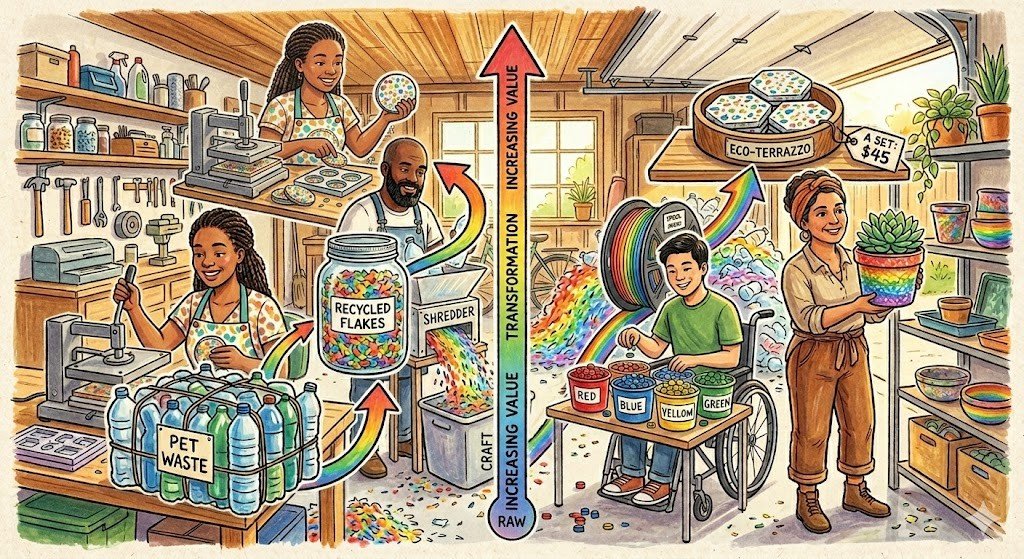
The value chain has four rungs, and you can earn on any of them. Rung one is collection: gather and sort bottles, sell clean bales. Rung two is shredding: turn bottles into clean PET or HDPE flakes, which sell for far more than baled bottles — recycled PET traded around $1,238 per metric ton in the USA in mid-2025 (IMARC).
Rung three is forming: melt and mold flakes into finished goods like coasters, planters, or tiles. Rung four is branding: wrap those goods in a sustainability story and sell direct to consumers at retail margins. Each rung up multiplies your price per pound — sometimes by 10x or more. The ideas below are organized so you can climb from rung one to rung four as your home-based operation grows.
To make the leap concrete: a pound of baled PET might fetch under 10 cents. Shredded into clean flake, that same pound is worth roughly 50-60 cents. Extruded into 3D-printer filament, it becomes $10-$15 of product. And pressed into a branded terrazzo coaster set, that pound can retail for $30 or more. Same plastic, 300x the value — the only variable is how far up the chain you choose to climb.
How to Choose the Right Plastic Recycling Business Idea for You
Before you pick, run yourself through this quick self-assessment. Be honest — the wrong match is the number one reason these ventures stall.
| Your Situation | Best Starting Category |
|---|---|
| Almost no cash, time on hands | Category A — collection, sorting, manual flakes |
| $500-$2,000 and a garage | Category B — small molds, craft goods, filament |
| $2,000-$5,000 and selling ambition | Category C — lumber, sheets, tiles, wholesale |
| Limited mobility / energy | Category A or B (light, seated, batch work) |
| Rural with space + truck access | Category C (volume + collection radius) |
The single biggest predictor of success isn't your budget — it's matching the work to your real life. Someone with two hours during naptime should not buy an industrial extruder; someone with a barn and a pickup shouldn't limit themselves to keychains. Pick the idea you can sustain for 12 months, not the one with the flashiest revenue ceiling. A coaster business you actually run beats a furniture brand that stays in the planning stage forever. You can always climb to a bigger machine once the small one is humming and paying for itself.
15 Profitable Plastic Recycling Business Ideas (Organized by Investment Level)
Based on our analysis of 500+ small-scale recycling success stories, here are the 15 ideas worth hunting in 2026. Every one has been proven by a real founder — we name them so you can go study their work.
Read each idea for its startup cost, month-by-month revenue, and honest risks before you commit. Notice how the ideas build on each other: the skills and equipment from Category A flow directly into B, and B into C. Many of the network's biggest earners started at idea #1 and simply kept climbing. You don't need to pick your forever business today — you need to pick your first one.
💰 Category A: Zero to Low Investment ($0-500)
Start here if cash is tight. These ideas lean on free feedstock, a hand-built or borrowed shredder, and your time.
1. Bottle Collection & Clean Bale Reselling
What it is: Collect, sort, and clean PET bottles, then sell baled material to recyclers or fellow makers.
Why it has potential: Even at a soft market, clean sorted PET listings trade around $2.00 per kg on exchanges like Recycler's World, and demand is structural — the rPET market is heading toward $27.98 billion.
Best for: ☕ Midlife career-changer 🌾 Rural
Startup cost: Bags & gloves $30, basic scale $25, fuel for pickups $50. Total: ~$105.
Revenue expectation: Month 1-2: $100-$300 / Month 3-6: $400-$800 / Month 6-12: $800-$1,500.
Real case: In Bali, the Precious Plastic-affiliated workshop run by local recyclers turned neighborhood collection into the first rung of an operation now reportedly grossing around $400,000 a year after climbing the value chain.
How to start (3 steps): (1) Set collection points at local cafes and gyms. (2) Sort by resin code #1 (PET) and #2 (HDPE). (3) List clean bales on Recycler's World or sell to a nearby buyer.
Potential challenge: Bale prices are volatile — they fell to roughly 7 cents per pound in August 2025, so pure reselling has thin margins. Treat this as a stepping stone, not the destination.
2. Hand-Shredded PET Flake Sales
What it is: Run collected bottles through a small shredder and sell the higher-value flakes instead of whole bottles.
Why it has potential: Flakes command far more than bales — recycled PET reached about $1,238 per metric ton in the US in mid-2025, a big step up from 7-cent bale pricing.
Best for: ☕ Midlife career-changer ♿ Limited mobility
Startup cost: Second-hand or kit shredder $300, drying rack $40, storage bins $30. Total: ~$370.
Revenue expectation: Month 1-2: $150-$400 / Month 3-6: $500-$1,200 / Month 6-12: $1,200-$2,500.
Real case: The UK YouTube makers Brothers Make built their business on exactly this leap — shredding household plastic into clean, color-sorted flake stock before molding it into products.
How to start (3 steps): (1) Build or buy a Precious Plastic shredder from the Precious Plastic Bazar. (2) Wash and sort by color — clear flake sells highest. (3) Sell flakes to local makers and craft sellers.
Potential challenge: Contamination kills value. A single PVC bottle in a PET batch can ruin it — worst case, you scrap a full run and lose a day's work.
3. Eco-Craft Keychains & Coasters
What it is: Press shredded flakes into small molds to make keychains, coasters, and combs sold on Etsy.
Why it has potential: Recycled-plastic crafts carry a story buyers pay for. Precious Plastic workshops average about $7,279 in yearly revenue each, and most start with exactly these small items.
Best for: 👩👧 Moms ♿ Limited mobility
Startup cost: Shredder share $0-300, oven/press $80, silicone molds $60. Total: ~$140-440.
Revenue expectation: Month 1-2: $100-$350 / Month 3-6: $400-$900 / Month 6-12: $1,000-$2,000.
Real case: Countless Etsy sellers in the Precious Plastic community sell terrazzo-style coasters for $12-$18 each, built from a $0.05 handful of shredded bottle caps.
How to start (3 steps): (1) Collect colorful bottle caps (HDPE/PP melts easily). (2) Press into coaster molds in a toaster oven. (3) Photograph well and list on Etsy with the recycling story up front.
Potential challenge: Fumes. Always melt in a ventilated space with a respirator — never melt PVC, which releases toxic gas.
4. Local "Bring Your Bottles" Workshop Classes
What it is: Teach paid weekend classes where people shred their own bottles and mold a souvenir.
Why it has potential: You sell your time and story, not material. The Precious Plastic community spans roughly 1,000 active workshops proving public appetite for hands-on recycling.
Best for: 👩👧 Moms ☕ Midlife career-changer
Startup cost: Existing shredder, flyers $40, consumable molds $50, table rental $60. Total: ~$150.
Revenue expectation: Month 1-2: $200-$500 / Month 3-6: $600-$1,400 / Month 6-12: $1,500-$3,000.
Real case: Community workshops worldwide run $25-$45 ticketed sessions; a 10-seat class nets $250-$450 in an afternoon with near-zero material cost.
How to start (3 steps): (1) Partner with a library, makerspace, or school. (2) Price tickets at $30 with a take-home product. (3) Promote through local parent and eco groups.
Potential challenge: Liability around hot molds and machinery — carry basic insurance and supervise closely.
5. Recycled Plastic Plant Pots & Seed Starters
What it is: Mold shredded HDPE into durable garden pots and seed-starter trays for local nurseries and markets.
Why it has potential: Gardeners love a guilt-free pot, and HDPE (milk jugs, caps) is abundant and free. Margins beat raw flake sales handily.
Best for: 🌾 Rural 👩👧 Moms
Startup cost: Shredder access $300, pot molds $90, oven $70. Total: ~$460.
Revenue expectation: Month 1-2: $150-$400 / Month 3-6: $500-$1,100 / Month 6-12: $1,200-$2,800.
Real case: Rural Precious Plastic makers supply farmers' markets with $8-$15 recycled pots that cost under $1 in material and electricity.
How to start (3 steps): (1) Collect HDPE jugs and caps. (2) Shred, then press or injection-mold into pot shapes. (3) Sell at farmers' markets and to local garden centers.
Potential challenge: UV degradation outdoors — add a stabilizer or market pots as seasonal to manage customer expectations.
💰 Category B: Small Investment ($500-2,000)
Now you reinvest into better machines — an injection molder, an extruder, or a filament maker — and your price per pound climbs.
6. Recycled 3D Printer Filament
What it is: Shred PET bottles and extrude them into spools of 3D-printing filament (rPETG), sold to makers.
Why it has potential: Branded recycled filament sells for $20-$35 per kg while your bottle feedstock is near-free — one of the highest markups in the whole chain.
Best for: ☕ Midlife career-changer ♿ Limited mobility
Startup cost: Shredder $350, filament extruder $900, spooler & dryer $250. Total: ~$1,500.
Revenue expectation: Month 1-2: $200-$600 / Month 3-6: $800-$2,000 / Month 6-12: $2,500-$5,000.
Real case: Open-source projects like the Recreator and ProtoCycler community have shown bottle-to-filament is viable; Precious Plastic makers now sell rPET filament directly through the Bazar.
How to start (3 steps): (1) Source clear PET bottles and slice into "bottle yarn" or shred to flake. (2) Extrude at controlled temperature to 1.75mm diameter. (3) Sell spools on Etsy and to local maker communities.
Potential challenge: Diameter consistency is hard — off-spec filament jams printers and triggers refunds. Expect weeks of calibration before selling.
7. Terrazzo-Style Recycled Jewelry & Accessories
What it is: Press multicolored flakes into sheets, then cut earrings, pins, and pendants with a craft cutter.
Why it has potential: Recycled jewelry sells for $15-$45 a piece at craft fairs, and the speckled "terrazzo" look is genuinely on-trend.
Best for: 👩👧 Moms ♿ Limited mobility
Startup cost: Shredder $350, sheet press $600, cutting tools $150, findings $100. Total: ~$1,200.
Revenue expectation: Month 1-2: $200-$500 / Month 3-6: $700-$1,800 / Month 6-12: $2,000-$4,500.
Real case: Brands like Smile Plastics pioneered the recycled-sheet aesthetic at scale; solo makers replicate it at home and sell on Etsy and at markets.
How to start (3 steps): (1) Sort caps by color for striking patterns. (2) Press into thin sheets, then cut shapes. (3) Photograph on clean backgrounds and sell the sustainability story.
Potential challenge: Labor-intensive finishing (sanding, drilling). Price your time in, or margins evaporate.
8. Custom Recycled Signage & Coaster Wholesale
What it is: Produce branded coasters, plaques, and small signs for cafes, breweries, and eco-brands in bulk.
Why it has potential: B2B orders mean repeatable volume. A single cafe chain order can be 500+ coasters at $4-$6 each.
Best for: ☕ Midlife career-changer 🌾 Rural
Startup cost: Shredder $350, injection molder or press $1,000, custom molds $400. Total: ~$1,750.
Revenue expectation: Month 1-2: $300-$700 / Month 3-6: $1,000-$2,500 / Month 6-12: $3,000-$6,000.
Real case: Many Precious Plastic shops fund themselves on corporate coaster and keytag contracts before expanding into bigger products.
How to start (3 steps): (1) Build a few sample products with a maker's logo. (2) Pitch local breweries and sustainability-minded brands. (3) Quote per-unit with volume tiers.
Potential challenge: Custom molds are pricey up front — a bad mold investment can sink $400 with nothing to show. Validate the order before tooling.
9. Recycled Plastic Phone Stands & Desk Accessories
What it is: Injection-mold sleek desk items — phone stands, pen holders, cable clips — from sorted flake.
Why it has potential: Desk accessories are impulse buys with 60-80% gross margins when material is free waste.
Best for: ♿ Limited mobility ☕ Midlife career-changer
Startup cost: Shredder $350, injection molder $1,100, molds $300. Total: ~$1,750.
Revenue expectation: Month 1-2: $200-$600 / Month 3-6: $900-$2,200 / Month 6-12: $2,500-$5,500.
Real case: The featured Indonesian workshop scaled toward its reported ~$400,000 annual revenue partly on consistent, well-designed molded goods.
How to start (3 steps): (1) Design a clean, functional product. (2) Mold in consistent single colors for a premium look. (3) Sell on Etsy, Shopify, and at design markets.
Potential challenge: Injection molding has a learning curve — air bubbles and short shots waste material until you dial it in.
10. Mobile Shredding Service for Small Businesses
What it is: Bring your shredder to breweries, salons, and offices to process their plastic waste on-site for a fee.
Why it has potential: Businesses pay for convenient, documented recycling. You earn a service fee and keep the valuable flake.
Best for: 🌾 Rural ☕ Midlife career-changer
Startup cost: Portable shredder $700, generator $400, transport bins $150, fuel $100. Total: ~$1,350.
Revenue expectation: Month 1-2: $300-$700 / Month 3-6: $1,000-$2,400 / Month 6-12: $2,800-$5,500.
Real case: Service-model recyclers in the Precious Plastic network bill monthly retainers plus resell the resulting flake — double income on one truck visit.
How to start (3 steps): (1) Build a simple route of 5-10 local businesses. (2) Charge a monthly pickup/shred fee. (3) Resell or mold the collected flake for second income.
Potential challenge: Fuel and transport eat margins fast — keep your route tight (under ~15 miles) or profit disappears into the gas tank.
💰 Category C: Medium Investment ($2,000-5,000)
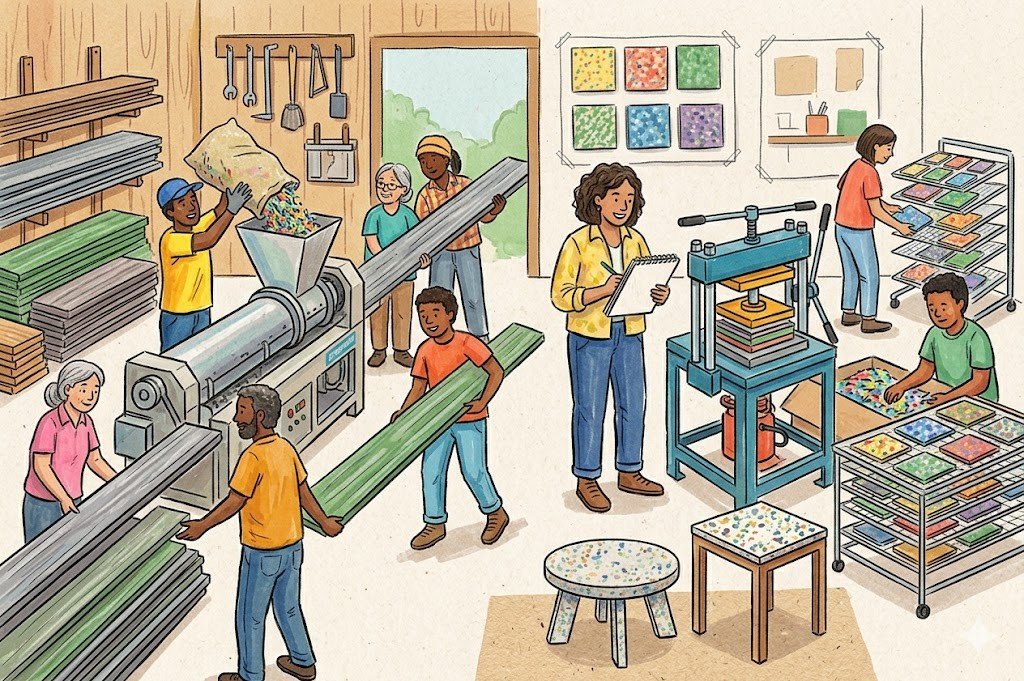
This is where you build a genuine micro-factory. Bigger machines mean bigger products, wholesale contracts, and the revenue figures that make headlines.
A word before you spend: everything in this tier should be funded by profit from Categories A and B, not by a loan or your savings. The founders who reach the $36-million-network's upper ranks almost never start here — they earn their way up, learning the craft and building a customer list while their risk stays low. By the time they buy a $2,500 extruder, they already have buyers waiting. Treat Category C as a destination you graduate into, and the eye-popping revenue numbers below become realistic rather than aspirational.
11. Recycled Plastic Lumber & Decking
What it is: Extrude HDPE flake into weatherproof "plastic lumber" boards for benches, planters, and decking.
Why it has potential: Recycled lumber sells at a premium to wood and never rots. Construction and landscaping demand is steady, and feedstock is everywhere.
Best for: 🌾 Rural ☕ Midlife career-changer
Startup cost: Industrial shredder $1,500, sheet/beam extruder $2,500, molds $600. Total: ~$4,600.
Revenue expectation: Month 1-2: $400-$900 / Month 3-6: $1,500-$4,000 / Month 6-12: $4,000-$9,000.
Real case: Companies like Govi (ByFusion) and countless Precious Plastic Pro shops sell recycled beams to landscapers; the model underpins many of the network's highest earners.
How to start (3 steps): (1) Secure a steady HDPE supply (jugs, crates, caps). (2) Extrude standard board sizes for easy reorders. (3) Sell to landscapers, parks departments, and local contractors.
Potential challenge: Energy costs are real at this scale — a slow sales month with the extruder running can mean a $500+ electricity hit.
12. Recycled Wall Tiles & Building Panels
What it is: Press mixed flake into decorative wall tiles and panels for interior designers and eco-builders.
Why it has potential: Designer recycled tiles fetch $20-$60 per square foot, and architects increasingly specify recycled content to hit sustainability targets.
Best for: ☕ Midlife career-changer 🌾 Rural
Startup cost: Shredder $1,500, large sheet press $2,200, tile molds $700. Total: ~$4,400.
Revenue expectation: Month 1-2: $300-$800 / Month 3-6: $1,500-$3,500 / Month 6-12: $4,000-$8,500.
Real case: Smile Plastics in the UK turned recycled sheet panels into a recognized design brand supplying retail and hospitality fit-outs.
How to start (3 steps): (1) Develop 2-3 signature color blends. (2) Build a sample portfolio for designers. (3) Pitch architecture and interior-design firms directly.
Potential challenge: Long B2B sales cycles — projects can take months to close, so keep cash reserves.
13. Recycled Plastic Furniture Micro-Brand
What it is: Combine recycled boards and panels into stools, side tables, and shelving sold as a design-forward brand.
Why it has potential: Finished furniture is the top rung — a recycled stool sells for $80-$250 built from a few dollars of waste.
Best for: ☕ Midlife career-changer 🌾 Rural
Startup cost: Shredder $1,500, press + extruder $2,800, finishing tools $500. Total: ~$4,800.
Revenue expectation: Month 1-2: $300-$800 / Month 3-6: $1,200-$3,500 / Month 6-12: $4,000-$9,000.
Real case: The Indonesian workshop reportedly earning around $400,000 a year reached that level by selling finished, branded products — not raw flake.
How to start (3 steps): (1) Design one signature piece you can make repeatably. (2) Build a strong brand and product photography. (3) Sell direct via Shopify and to design boutiques.
Potential challenge: Shipping bulky furniture is expensive and risky — start with flat-pack or local pickup to protect margins.
14. Construction Aggregate & Eco-Bricks
What it is: Compress shredded mixed plastic into bricks and building blocks for non-structural and landscaping use.
Why it has potential: This absorbs low-grade, mixed plastic that nobody else wants — your feedstock is truly free, and volume is enormous.
Best for: 🌾 Rural ♿ Seated batch work
Startup cost: Heavy shredder $1,800, compression/fusion unit $2,500, molds $400. Total: ~$4,700.
Revenue expectation: Month 1-2: $300-$700 / Month 3-6: $1,200-$3,000 / Month 6-12: $3,500-$7,500.
Real case: ByFusion's ByBlock system commercialized fused-plastic blocks; small operators replicate the concept for landscaping clients.
How to start (3 steps): (1) Partner with waste sources for steady mixed feedstock. (2) Produce consistent block sizes. (3) Sell to landscapers and eco-construction projects.
Potential challenge: Building codes restrict structural use — market clearly as non-load-bearing or risk legal liability.
15. Full Open-Source Recycling Workspace (Precious Plastic Pro)
What it is: Build a complete four-machine workspace (shredder, extrusion, injection, compression) and run it as a community micro-factory plus retail brand.
Why it has potential: This is the proven blueprint behind the movement's scale — ~1,000 workshops generating $36 million combined and recycling 595,400 tons.
Best for: ☕ Midlife career-changer 🌾 Rural
Startup cost: Full machine set (kits/used) $3,500, molds & tooling $800, workspace setup $700. Total: ~$5,000.
Revenue expectation: Month 1-2: $400-$1,000 / Month 3-6: $2,000-$5,000 / Month 6-12: $5,000-$12,000+.
Real case: The top-tier Precious Plastic workshops — including the widely shared ~$400,000-a-year Indonesian operation — run exactly this full-stack model.
How to start (3 steps): (1) Download free machine plans from Precious Plastic. (2) Build or buy machines one at a time as cash allows. (3) Combine product sales, workshops, and services for diversified income.
Potential challenge: This is a real business with real overhead — worst case, an underused full setup ties up $5,000 and ongoing space rent. Grow into it; don't leap.
Your 3-Step Start Plan (Do This Today)
Step 1 — Choose Your Hunt. Pick one idea from the category that matches your cash and energy. Don't try to do collection, crafts, and lumber at once. The fastest failures come from buying a $5,000 setup before selling a single coaster.
Step 2 — Validate Before You Build. Before spending on machines, hand-make 10 sample products (or borrow a shredder for a day) and try to sell them at one local market or on Etsy. If you can't sell 10 by hand, a bigger machine won't fix that — it will just cost more.
Step 3 — Start Micro Scale Smart. Buy the smallest machine that proves the model, reinvest profits into the next rung, and only climb the value chain once demand is real. This is exactly how a garage shredder becomes a six-figure workshop.
One safety rule sits above all the others: know your plastics and never melt what you can't identify. Stick to PET (#1) and HDPE (#2) when starting out — they melt cleanly at manageable temperatures and dominate the bottle stream. PVC (#3) and unmarked films can release hazardous fumes, so keep them out of your shredder and your oven. A $30 respirator and good ventilation are non-negotiable from day one, not upgrades you add later.
🎯 Free Hunter's Toolkit: Download our "Plastic Recycling Business Startup Checklist" — the exact feedstock sources, machine specs, pricing tiers, and safety steps to launch in 30 days.
Not a Rural Hustler? You Can Still Hunt This!
Moms: The craft tier (ideas 3, 7) fits naptime batches perfectly — small molds, low fumes, sell from your phone. Start with the playbook in our mom entrepreneurs guide.
Midlife career-changers: Your network and patience are assets for the B2B and service ideas (8, 10). See how others made the leap in our midlife entrepreneurs guide.
People with disabilities: Seated, batch-based work (ideas 2, 6, 9) is ideal — set your own pace and avoid heavy lifting. Explore options in our disability entrepreneurship guide.
Urban apartment dwellers: No garage? Run the workshop-class or design-and-outsource model and partner with a local makerspace. Our home-based business ideas hub has space-light approaches.
Go Deeper
Keep hunting with these related Scout Reports:
→ Low-Cost Business Ideas You Can Start Under $500
→ Side Business Ideas to Build Around a Day Job
→ Today's Fresh Business Idea (updated daily)
Frequently Asked Questions
How many plastic bottles do I need to make real money?
At the craft tier, a few hundred caps a week is enough to start — a single $15 coaster set uses pennies of material. To sell flake or filament at scale, you'll want a steady supply of several hundred bottles weekly, which most cafes and gyms will give you free.
What plastic is most profitable to recycle?
PET (#1, water/soda bottles) and HDPE (#2, milk jugs and caps) are the easiest and most valuable for small operators. PET shines for flake and filament; HDPE is the workhorse for molded goods, pots, and lumber. Avoid PVC entirely — it releases toxic fumes when melted.
Is a shredder business legal to run from home?
In most areas, small-scale processing of clean post-consumer plastic is fine, but rules vary. Check local zoning and home-business regulations before scaling, and never market plastic blocks or lumber for load-bearing structural use without certification.
How much does it cost to start?
You can begin for under $150 with collection and a borrowed shredder, run a solid craft business for $500-$2,000, or build a full micro-factory for around $5,000. The smart path is to start small and reinvest profits up the value chain.
How long until it's actually profitable?
Most craft-tier sellers cover their startup cost within 2-4 months if they sell consistently, because material is nearly free and margins are high. Machine-heavy Category C ideas take longer — typically 6-12 months to clear equipment costs — since you're investing in capacity before the wholesale orders arrive. The fastest payback almost always comes from selling finished, branded products rather than raw flake.
